

Introduction
The rise of oil prices in the recent years is putting huge inflationary pressures to the world economy. As oil prices is a very important economic variables that will affect the health and vitality of the world’s macroeconomy, an analysis of the supply and demand factors contributing to the prices changes of oil is crucial. By understanding the real root causes driving the oil prices in the world, researchers will be able to understand the fundamentals behind the volatility of oil prices in the turbulent economy environment today. With better understanding on the economic factors influencing oil prices, better prediction on future oil prices, based on historical lessons, can be formed. In this essay, the trends in the patterns of demand and supply of oil during the period 2000-2005 will be presented. Besides, the relationships of oil prices to quantity demanded for oil will also be discussed.
An Analysis of Supply and Demand Factors Affecting Oil Prices
As shown in Figure 1 below, it can be seen that oil prices is on a generally increasing trend from year 2000 to 2005. As it is shown clearly, the rising oil prices is generally caused by the increasing demand for oil throughout the years. It is easy to observe from the figure that whenever the rate of year to year increase of oil demand shoot up, the oil prices tend to rise sharply as well. From such observation, it can be roughly concluded that the rising oil prices from year 2000 to 2005 is due to the increase of demand for oil. However, that is just a simplistic view. There are many other factors contributing the rise or the fall of oil prices during the period as well. All these will be further discussed in the paragraphs below.
Before moving to next topic, it is worth to mention the fundamental driving forces contributing to the increasing demands of crude oil around the world. The various demand factors include:
The rising fuel/ energy consumption of developing country. A review of the academic journal found that the rising crude oil prices can be largely attributable to the rising consumption needs by emerging countries. The huge populations in the BRICS countries are often cited to have pushed the oil prices up significantly (Skeer et. al., 2007). As the economy grow in these countries, people have higher purchasing power, and hence tend to consumer more products and energy. For example, in China, when people are getting wealthier, they tend to purchase new vehicles (such as cars) for transportation purposes. Such a phenomena place huge demand on oil, and hence, pushed up oil prices significantly.
The growing economy around the world. Besides emerging countries, from 2000 to 2005, the world economy is growing well. As such, people tend to consume more energy. For example, when people have more money, they may travel more to visit to other countries. They may also more willing to spend money, and ultimately, this had caused the energy consumption to increase significantly. The end result was rising crude oil prices.
The depletion of crude oil. The fast rising oil prices is also due to the famous arguments that crude oil is a depleting natural resources (Hamilton, 2009). It is widely argued that with such a consumption rate, the supply of oil is not sustainable. As something getting scare, the price tend to jump up a lot.
The effects from speculation. Consistent with the argument that oil prices are depleting, people are expecting that oil prices will increase sharply (Adelman, 2004). This creates a sentiment whereby oil prices are being pushed up by speculators.
Figure 1: Oil Prices and the Increasing Demand

Source: http://www.iea.org/
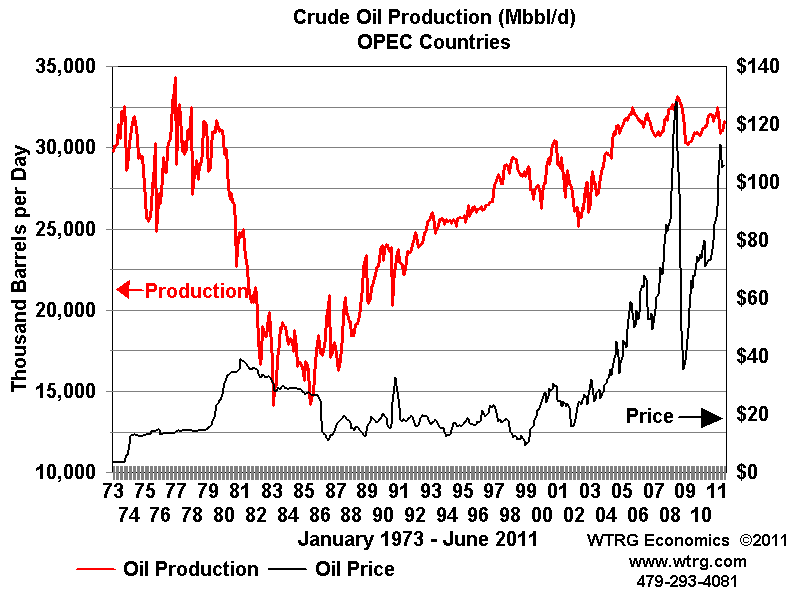
As discussed above, the rise of demand is observed to be the driving force creating the phenomenon of increasing oil prices in the period of 2000 – 2005. However, that is just half of the picture, as oil prices will be affected by the supply factors as well. In Figure 2, the supply of crude oil is presented. It can be observed that the in the period under investigation (2000 - 2005), the supply of crude oil is relatively constant. There were just minor changes (both increases and decreases) of crude oil production volume by the OPEC countries. As OPEC is the key suppliers of crude oil in the world, it can then be commented that the supply of crude oil from 2000 – 2005 is relatively constant (or at best, moderate increases in supply, when compared with the sharp increases in demand of crude oil). Thus, combining such finding with the previous discussions that the demand of crude oil is increasing at a fast rate, it is then rationale to observe that crude oil prices had increased tremendously in the time period discussed.
Figure 2: Supply of Crude Oil and the Changes in Oil Prices

Source: http://www.wtrg.com/oil_graphs/PAPRPOP.gif
Apart from that, it is also widely acknowledged that the changes of crude oil prices can also be affect by market sentiments (Oladosu, 2009), which are in turned being influenced by the major breaking events happening around the world. The impacts of world events to the crude oil prices are shown in Figure 3 below. It can be seen that, over the shorter terms, the happening of crude oil prices can be affected by the events, when speculators bid up or down the oil prices depending on the nature of the events or news. This is consistent with daily observation on crude oil prices in the financial magazines or news. However, all of these events have shorter impacts toward crude oil prices.
Figure 3: World Events & Crude Oil Prices (2001-2007)

Source: http://www.wtrg.com/oil_graphs/crudeoilprice0105.gif
Relationships between Oil Prices and Quantity Demanded
Generally, for any commodity, there exist inverse relationships between prices and quantity demanded. This is similar to oil prices behaviors as well. Several reasons can explain such phenomenon. Firstly, when prices increases, people tend to spend less on that item. This is because the marginal utility from such purchase had decreased. Besides, when the prices had increasing significantly, people tend to find other substitutes. In the context of oil prices, it can be seen that businesses and people are fast to switch to driving hybrid cars and finding alternative energy for daily consumptions purposes. Even when in the short term, where the development and innovation of alternative energy is not able to fully substitute the consumptions and demand of oil prices, people may tend to cut down their travelling activities or consumption of oil prices.
However, it is worth to mention that such an inverse relationships between oil prices and quantity demanded may not hold true all the time. For example, when the oil prices increases a lot, people may start getting worried and stock up crude oil (Saporta et. al., 2009), and hence further pushing up the quantity demanded and oil prices significantly (i.e., positive relationships instead). Besides, when the sentiment such as depletion of crude oil is unavoidable, speculators may bid up the prices for crude oil (Milani, 2009), and hence, creating a phenomenon whereby as the oil prices goes up, the quantity demanded may increase as well. Such a situation may hold on until the commodity bubble burst.
Implications for Individual, Firms and Government
There are many impacts of rising crude oil prices for individuals, firms and government. For individuals, it is obvious that they should cut down unnecessary consumptions on fuel oil. They should change their consumption habits accordingly, and to switch to consumption of other sort of energy. For businesses, cutting down fuel consumption is necessary as well. Besides, it is crucial for firms to apply innovation and creativity to reduce fuel consumptions in operations, or to develop new technologies that are less dependent on fuel consumptions. For automotive companies, introduction of fuel efficient or hybrid cars are good examples on how the firms can benefit the society and the companies itself. For government, they should implement policies encouraging development of alternative energy for sustainable development of the economy (Das, 2007). Besides, government can impose taxes upon activities that waste fuel consumption and yet create pollution to the environment.
Conclusion
In conclusion, it can be seen that like any other commodity, crude oil is affected by supply and demand factors. Depending on the interaction of these various forces affecting the supply and demand of the crude oil, the price level will change accordingly. In the article, it is discussed that the demand factors include increasing consumptions by people, sentiment issues, and the depletion of crude oil in the world. The supply factor is mainly affected by production volume by OPEC and other oil producing countries. Due to the sharp increases in oil prices, people must find new substitute – by developing alternative energy sources for sustainable development in the future.
References & Bibliography
Adelman, M. A. (2004). The Real Oil Problem. Regulation, 27(1), 16-21.
Chen, S. (2009). Revisiting the Inflationary Effects of Oil Prices. The Energy Journal, 30(4), 141-154.
Das, S. (2007). THE CRUDE OIL MOVE: IMPLICATION FOR ASIA? Regional Outlook: Southeast Asia,68-71,146.
Felder, F. A. (2007). Oil Honesty. Harvard International Review, 28(4), 5.
Hamilton, J. (2009). Understanding Crude Oil Prices. The Energy Journal, 30(2), 179-206.
Matthies, K. (2005). Oil Prices Out of Control? Intereconomics, 40(4), 178-179.
Milani, F. (2009). Expectations, learning, and the changing relationship between oil prices and the macroeconomy. Energy Economics, 31(6), 827.
Oladosu, G. (2009). Identifying the oil price-macroeconomy relationship: An empirical mode decomposition analysis of US data. Energy Policy, 37(12), 5417.
Owen, N., Inderwildi, O., & King, D. (2010). The status of conventional world oil reserves - Hype or cause for concern? Energy Policy, 38(8), 4743.
Saporta, V., Trott, M., & Tudela, M. (2009). What can be said about the rise and fall in oil prices? Bank of England. Quarterly Bulletin, 49(3), 215-225.
Skeer, J., & Wang, Y. (2007). China on the move: Oil price explosion? Energy Policy, 35(1), 678.
Wirl, F. (2008). Why do oil prices jump (or fall). Energy Policy, 36(3), 1029.
(Visited 18 times, 1 visits today)

Related Post



Leave a comment